Tuesday, May 17, 2016

BIG BOOX, Discovery and Sales

Book Expo America is the annual trade fair for the publishing industry, where everyone involved in the production (authors to book binders) and marketing of books comes together to mingle, show off, share, buy, sell, and tout the big products (aka books) they are pitching for the fall and winter. BEA was held at McCormick Place in Chicago, the vast, spotlessly modern convention center. This was my first trip to the fair. As a young publisher, I went full of curiosity and excitement; eager to learn. The amazement and absurdity were bonuses.

I attended helpful workshops hosted by industry leaders on topics like making better use of the data that we publishers provide about our new titles when we complete industry questionnaires. I learned how to use these data forms to push sales. I learned how to put Advanced Reader Copies (galleys) on line to make them available to more people. All this is about discovery: ways to lead librarians, book buyers, and reviewers to my authors' books, somewhat easing the pressure of active marketing. Hooray and thank you, Book Expo!

All of us present for these workshops were deeply engaged. We were wide-eyed and alert as Power Point slides flashed by. iPhone cameras snapped at screens that revealed savvier sales strategies. All of us need to sell more books, so while we listened, each was undoubtedly projecting how to improve book discovery a.s.a.p. back home. I sure was.


Still, oddly, the whole experience of Book Expo made me ask an illogical question: Are more books sales always an unquestioned good?

I sure want more book sales for Upper Hand Press! Sales earn money for the Press to be self-sustaining. Increased sales will allow me to compensate my authors as they deserve to be. 

Beyond the simple and obvious need for a business to have income, big sales are the deep heart of why I am publishing. I represent authors whom I have chosen because I value them for the importance of their writing. They should have as many readers as possible. My company is here to serve my authors and to serve readers by introducing them to the literary pleasures and valuable human content these authors offer. Their years of hard work——the cultivation of their art——and what I do to promote them should make a living for all of us. Publishing is intense, hopeful work, not all of it creative in the sense of inspired.

The greater our sales, the more readers we are reaching. When we sell books, the more money I have to bring them to ever-wider audiences. It's a hopeful cycle, and one I expect to grow over the months and years. The reputation of each book and each author should keep growing to acquire a devoted following and an expanding one. 

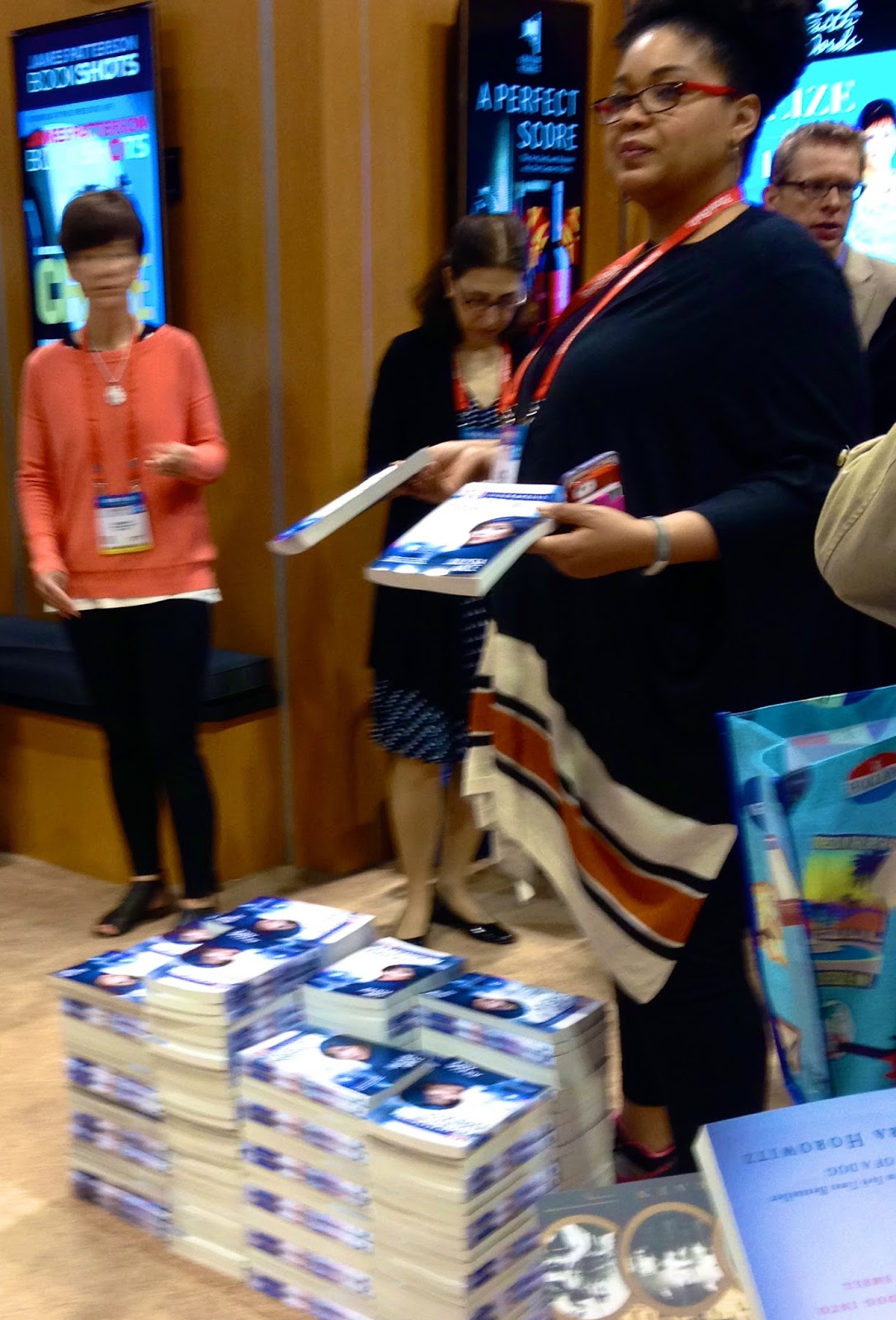
The exhibition hall upstairs at BEA is where the expected and usual image of book-selling success was on display: banners, best-sellers, authors' head-shot pictured against back-grounds of snappy copy; people lined up for hours to have their free ARCs of new titles signed by sleekly-dressed authors. In short: It's Hollywood, it's Entertainment, where books are the byproduct of brand marketing. 

This is where you find the branding and sales of a few stars whom we have ceased to think of as authors and understand to be entertainers. These writers are often as good as those who don't get large contracts. Still, I find myself wondering what the writers' talents and years of work have brought to the banners and what well-funded marketing, publicity, and graphics departments have. Perhaps there's an imbalance?

Consciously or not, this is what most note-taking workshop aspirants are aiming toward. It's become the image of what success as a writer is "supposed to be." On a smaller scale it's front table displays at Barnes and Noble: the anointed selection of a few BIG BOOX. 

Are more book sales an unquestioned good? What do we mean by more? The question is which books are publishers out to sell?

Most publishers have front and back lists, the front list being the newly released books for the current season. These are launched with the fabulously expensive and extravagant marketing campaigns that make Book Expo such a showcase for graphic- and set- designers, and a Candyland of give-away ARCS, catalogues, branded tote bags, and little chocolate candies. 

Each publisher ("vendor") had a booth, many big enough to be arranged like stores with two or three sides of well-lit shelves of their books, decorated with posters and mountains of give-away
ARCs. There were easy chairs for reading, carpeting deep enough to sink you weary toes into; tables for signings, and plenty of amiable staff to lure you into the books. While many of the company's books are displayed, the new books are conspicuously featured and are distributed to all comers freely and, one supposes, at significant expense to the publisher. Make no mistake: these featured books are the ones you will read about in prominent reviews and popular magazines; whose authors will appear and on television and radio interviews. The marketing and publicity machines behind them are phenomenal.

I have nothing at all against these much-touted books and certainly not against their fortunate and hard-working authors. But it certainly does worry me that so much expense, fanfare, and public notice is focused on so very few titles when so many worthy authors and manuscripts go begging. 

It distressed me—it concerned me—to see such unflinching confidence in a publishing industry that show little regard to promote variety, depth, or books as a consistent matter of literary culture as opposed to commerce and entertainment. Here, books were almost a byproduct of the industry that has grown around them; they are the by-products of publicity, marketing, and the services that provide then. Don't authors get the ball rolling?

At Upper Hand Press, may we make our sales by bringing out good books and attracting readers to the minds and deeds of our fine writers. Some of our authors have submitted to and been rejected by the presses that are filling McCormick place with banners for one or two books, giving away thousands of galleys for those couple of titles, and planning Hollywood media campaigns for what once was called literature. Some of our authors have been accepted by those presses and chose us instead. You might begin to see why.


Friday, April 22, 2016

Independent Bookstore Day April 30

Independent Bookstore Day is Saturday, April 30. Show up. Buy books! You know you've been keeping a list. It's in your head; it's on all those scraps you've torn out from the New York Time Book Review or Entertainment Weekly; it's your mental list of titles rejected by your book club. And—oh yes!—it's those Upper Hand books you keep planning to order and pre-order. Do it on April 30 at your local independent bookstore.

It's the treat your children love, to pick out books of their own to keep and to read aloud to you. Do they have birthday parties coming up? Help them pick the "gifts that keep on giving." 

You'll find the recommendations of your well-read book sellers posted in the stacks to give you stimulating ideas for good books to read. Those people are there to share their informed enthusiasm. They sincerely want to get to know you and your tastes. They want you to keep coming back to buy books, but they also seek you out to be an active member of a community engaged by ideas and discussion.

The people who own and operate independent bookstores have bucked the tide. It wasn't long ago that small, local, independently-owned stores were closing apace, being replaced by enormous chain stores. That trend meant—and means—much less variety for readers as mega-stores choose to deal with mega-publishers offering a simplified selection of books and more of fewer authors. 

The resurgence of independents run by inspiring people determined to make the difference in their communities is a boon for readers and for writers. 

If independent bookstores were only to offer you the books available in Barnes and Noble, though, wouldn't we think something were missing? The link between chain bookstores and the conglomerate book publishers is established. Small publishers aren't welcome. We look to the support of the independent stores to help introduce the voices of our authors—the authors we publish because they have distinctive, unusual, and independent outlooks.

When you visit and celebrate your excellent independent bookstore, look for our books on the shelves. If you don't find them, ask for them: Order them for yourself, and help create demand for Upper Hand titles with the individually-run stores that need your business too.
 

Friday, April 15, 2016

Love Triangle: You, Your Library, and Upper Hand Press

If you are reading this, I hope you count yourself among the lovers of the indie  movement, supporters of this independent press and, we hope, the taste-making independent book stores that serve you.

"Independent" usually means "small." In the publishing world, there are degrees of small. My one-person press is called "micro-"…for a reason!

An adjective that is too often unthinkingly attached to "small," though, is "struggling," as in "a small, struggling, independent press." It sounds so sad and ill-fated. Sorry, folks: This press is anything but.

I hope that any going concern continues to struggle. There needs to be a continual urgency to the effort to make publishing work for the authors I've signed and for the whom readers I want to meet those writers. It's not a matter only of making splashy debuts, but of keeping the shoulder to the grindstone for the long run—keeping Upper Hand books in print and promoting them continually.

Still, we have to sell books on a steady, regular basis if we will be able to stick to our mission. One of the greatest buyers of books is libraries. And the best ways to get books into libraries is to have library patrons request them.


Clyde Doesn't Go Outside has already been collected by many children's departments. It's a great story-time book. Our novels—One Hundred Years of Marriage, The Naming of Girl, Saving Phoebe Murrow, and Cadillac, Oklahomaare fascinating reads for both individuals and book clubs.

Libraries can pre-order books that have not yet been published (as you can too). Library orders can be made through the Upper Hand Press website or through the library's favorite distributor. 

If you get in the habit of requesting Upper Hand Press books at your library, you can keep the "struggling" away from our name and give us the Upper Hand more quickly.

Thanks for making the effort!

—Ann Starr


Monday, April 11, 2016

Consumer Education: BUY OUR BOOKS—But please, DON'T BUY THEM ON AMAZON

Upper Hand Press's 2016 is a big year for a small press: We have already published Zach Snyder's unique, quirky, and spectacularly beautiful picture book, Clyde Doesn't Go Outside. 

We expect Rhonda J. Williams' debut novel, The Naming of Girl, to make a splash with adults and young adults both. We may have just lost Harper Lee, but the themes of To Kill a Mockingbird reappear in Williams' book, where a young, rural southern girl learns through tough experience about racial conflict and human nature. Girl Brown presents charged issues to us in a way that is challenging, often funny, and recognizably contemporary. The books is conversation-starter for our moment in America.

During the summer and fall we will release three books, including a second edition of Louise Farmer Smith's classic One Hundred Years of Marriage, which will be expanded by book club notes and an interview with the author. Smith's new novel, Cadillac, Oklahoma, will come out in November, introducing readers to the kind, colorful, shocking, risible, and always whole-hearted folks of this Great Plains town—one that might remind you a little bit of Winesburg, Ohio.

We are proud to debut another novelist, Herta B. Feely, with Saving Phoebe Murrow. Feely's fiction, set in Washington D.C., mixes a sympathetic study of stresses within a socially well-placed family with the suspense of a crime story. We follow a case of teen cyber-bullying that has extreme consequences for parents, children, and community structure.

Now that you know what lies ahead, BUY OUR BOOKS! Be the first to own them by ordering them right now. They will be shipped directly to you upon publication (see Upper Hand Press and be directed to ordering information.)

Many readers order and pre-order books from Amazon as a matter of course. Please, order ours from us or from an independent bookstore! This matters.

Let me explain. When you order a book directly from a small press (which will fulfill your order immediately, just like Amazon) the press receives
one hundred per cent of the cover price. We sell One Hundred Years of Marriage for $18.00; we collect $18.00 to plow back into the Press. The author gets a twenty-percent royalty on the sale.

When you order the book through an independent book store, the bookstore keeps forty percent of the cover price to pay their rent, to pay their employees in their rewarding jobs, to contribute to their communities with their book clubs, story times, author visits and programming related to their communities. Those stores are citizens of their localities, and enrich them. When Upper Hand Press and our authors receive sixty percent of the cover price, we participate in communities of book lovers.  


Amazon, on the other hand, keeps a whopping fifty-five percent of the cover price of any book they sell. If they sell our $18.00 book, Upper Hand Press receives less than half, only $8.10. It's a rule of thumb in any business that in order to make a profit, you must at least double the cost of a product. The only one to profit from Amazon is Amazon.

Amazon is a bad habit you may not know you have, but it's one that cheats all the authors and publishers whose books you buy. The "great deals" you get don't come from the massive corporation's pockets: They come from the pockets of writers and publishers like Upper Hand. This press is trying to make enough money to keep going, to grow and to bring you more great authors who don't fit the Big Box mold. Please, be sure to buy them outside the Box too.

Friday, December 18, 2015

Album Notes

Morgan Powell's On and Off the Score is now for sale on CD Baby. It's worth looking at that site because it gives a lot of space for new information. There's a new bio, and there's also an excellent essay by the artist, who is well aware of the challenges his music poses for many listeners. I've copied his essay here, since it's an eloquent discussion of why it's worth it to find the patience for new experiences in art.
++++++++++++++++++++++++++                                                                                                        
Powell on Powell

CDs are classified by musical genre to simplify shopping. My work has never fit into a genre, though, because I’ve never composed with attention to traditional formula or system. This is handmade music, written out of my head with pencil, paper, and occasional recourse to a piano.
I have never used preexisting structures; I don’t use computers; I’m not affiliated with any school of composition. I borrow no licks or lines. If you sample each of the works on “On and Off the Score,” the diversity of work will be clear, for no piece sounds like any other. You won’t find a “style.”
The roster of musicians on this CD in itself hints at the indefinable quality of my music. These are all world-class performers, yet they are at the top of disparate genres: avant-garde, jazz, experimental and improvisational music; orchestral, chamber, and solo performance.
I composed the works on this CD for these, my wide-ranging world of friends, collaborators, and colleagues. They came from all over the literal map to record this music: Jim Staley, New York City; John Fonville, San Diego; Ray Sasaki, Austin; Steve Butters and Tomeka Reid, Chicago; Eric Mandat and Ron Coulter, Carbondale, Illinois; Edwin London and Howie Smith, Cleveland; Ariane Alexander, Philadelphia. Several of us are rooted in Champaign/Urbana, with ties to the University of Illinois: Dorothy Martirano, Michael Cameron, Armand Beaudoin and I. The Cleveland Chamber Symphony has its home city; the Tone Road Ramblers do just that. In all, over fifty musicians participated in recording the music on this CD. 
The oldest recording, “Zelanski Medley,” for the ineluctable Modality and Contemporary Chamber Players was in 1972 and the most recent, “Miscreant Angels” for Ariane Alexander, in 2015. 
I am grateful to all of these performers and to Ann Starr, the publisher of Upper Hand Press, who had the faith and courage to publish this CD of what many will consider unorthodox, strange, and difficult music.  
And all of those adjectives can be legitimately applied—if you forget that we are deeply programmed to hear only consonant music. The question is: whether it is worth it to you to experience dissonance and new sound; to discover the satisfactions that lie beyond your expectations? That depends on where you want to go with your sensibility.
This is not music you will relax to on the first or second hearing. Rather, it is music to listen to one piece at a time. With repeated listening, your mind adjusts to its sound and workings, and it discovers a new world on the other side of your patience. Science has established that Western minds are programmed to hear consonant music; but, with exposure, the mind will not only adjust to dissonance but will come to like it and be excited by where it takes you.
Again, is the experience worth it? I decided a long time ago that it is.

MP

Tuesday, November 10, 2015

Business, art, and opportunity for a small press

You would think that a publisher's first goal has to be selling enough to cover costs and remain in business. And in truth, as the owner of a fledgling press, my fingernails don't grow as fast as I can bite them down when I let a sensible anxiety over finances seize me.

But the fact is that I founded my press to celebrate and to promote artists I admire and believe in because they are excellent practitioners of their crafts and because they are substantial thinkers with rich ideas and experience to offer. Their work and thought enhance our own lives.

Composer Morgan Powell is a brilliant, genuinely unprecedented artist who has quietly created a tremendous body of scored and improvised compositions(the latter as a member of the Tone Road Ramblers sextet). Powell has never sought reputation, his musical process being so much a part of thoughtful living that to step away into promotion is to depart into an alien world inimical to the twin improvisatory processes of life and music.

In a world awash with recorded music, composers we haven't heard of tend to merge into a pounding headache of background noise. We feel annoyed and imposed upon even by free handouts of new CDs by unfamiliar artists, and especially when we’re asked to buy something cold. Why should we?

Music composition is a profession; for many, it’s a competition. For composer and improviser Powell, it’s art, launched by observation toward the end of new understanding—and new beginnings. There’s no looking back: Life is improvised from minute to minute moving forward, and this is how Powell composes. His third eye music creates sounds and form not from rules or traditions of music, but from the freedom of art.

So if listening to Powell's extraordinary, unfamiliar music sounds like a recommendation to eat your vegetables—it's good for you!—freedom has to have the same lack of appeal. Who knows what will happen when there are no rules that both bind but protect you? When there is nothing to tap your foot to, telling you that you are hearing "correctly?" What if the music is written so that you can listen with your own ears and mind open, taking what comes and interpreting it as you will, without needing an expert to tell you what you hear? With Powell's music, every listener is an expert because for every listener it is unprecedented—completely new. Sit back and let it float or drown you; lean in and delight in the brilliance and sweetness of the sound world Powell composes, offers to you, or ambushes you with.
  
Powell’s music is powerful, beautiful, efficient, and unprecedented in the challenges for the many virtuosos who commission it and play it. In Morgan Powell you will discover a composer you wish you’d discovered years ago because his music reminds you why humans make art in the first place.

Learn more about Powell; purchase the new CD, Morgan Powell On and Off the Score, and the monograph "Sounding Our Depths: The Music of Morgan Powell" at Upper Hand Press

This music is thought and image at least as much as sound—and such sounds you'll hear in your dreams, where you can't analyze them. It's art, here to make us explore and to go deeper.


It is a great privilege for Upper Hand Press to be the corner of the world where people can come to find or to discover this extraordinary artist. In deciding to support the work of a great composer who is off the charts, we are doing important work that would be neglected to the real detriment of our musical and intellectual culture. 

Is this the way for a small press to do business? And how! If we aren't for the rarities, who will be? What an opportunity for my press to promote Morgan Powell——and that is the bottom line.

Ann Starr, Publisher
November 9, 2015


Wednesday, September 9, 2015

Rejection Letters and Submission Fees: Doing Our Job

Few people in the position to select manuscripts for publication expect to earn the goodwill of the many more whose writings they decline. Rejection may become routine for writers, but it never feels routine. It never should. If it always stings, though, shouldn't there be some balm that's equally common? Apparently there is not.

What is a writer to do with a rejection letter? This problem is embedded in the standard process of submission. If one still submits on paper, s/he can always recycle returned pages in a fresh envelope, affix new stamps in the correct amount and send it off anew. If it's on an electronic submissions site, upload and get out the debit card.

If the writer wants to improve her chances at publication, it's hard to know what to do. Who knows why the manuscript was declined? Writers are rarely told a thing. Like a child whose parents are free to tell them only that, "No means No!" the author is infantilized by the publisher whose authority is equally absolute and baffling. Shall s/he revise? Is the work deficient? Or did an intern nix it before an editor laid eyes on it? 

Few writers learn much as the result of rejection. "Good luck with your career." "We receive more submissions than we can possibly publish." Did they read it, one aches to know.

For writers to be denied useful or revealing comment on their submissions speaks to irresponsible practices of publishers, whether we are asking for fees or not. Upper Hand Press asks for a $10 reading fee, and there are people who complain that this is not nice. Poets & Writers takes a position against this, but they do not have a position that suggests that publishers owe writers anything for the chance to read their work. 

Surely one reason editors can't comment to writers is the common practice of allowing multiple submissions: They are swamped. Writers too often submit indiscriminately despite publishers' requests that they do their homework before launching a barrage of manuscripts. 

Upper Hand requires exclusive submissions, and this undoubtedly limits our numbers for the good. From time to time we receive submissions that are very evidently shotgun efforts. I return these. If I am mistaken, the writer can always correct me, but so far no one has.  

It was with the deepest gratitude, then, and a sense that we are doing our job well that we received an email from a poet this week, directing us to a new, two-part post on her blog. In Gifted, Sheryl tells about meeting with me for drinks and discussion after Upper Hand Press had rejected her manuscript. 

While Sheryl writes about the things she learned through her contact with me, she can't write about the great value our meeting had for me. How often do publishers get to speak with the writers who approach them, to sound out their motives, why they wrote as they did, to discover the nature of their minds, where they see themselves coming from and going as artists, how writing fits into their lives as whole people. Such a discussion gives me more knowledge, more experience, and more empathy. It makes me a better, more sensitive editor and publisher. And it gives me a friend and writer to follow.

Sheryl's two posts, Gifted and Gifted (Continued) are gifts to me and to Upper Hand Press: We're doing what we set out to do. Thank you Sheryl!

Ann Starr